BioLever fast Discontinued
BL-AC10FS-A2 / 12 chips, Reflex side gold coating, CNF probe
BL-AC10DS-A2 / 12 chips, Reflex side gold coating, SiN probe

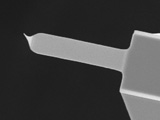
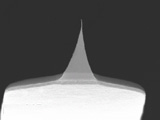
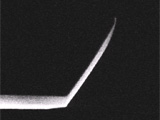
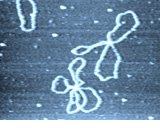
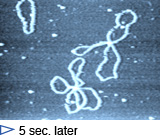
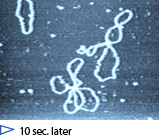
Video clips: Morphological changes of plasmid DNA
Simple but strong desire of a biologist had moved us to make this ultra small cantilever for observing dynamic behavior of bio molecular samples in liquid. Bio sample is active in liquid, where cantilevers receive large damping force so that they vibrate slower rather than in air. Our challenge in the cantilever fabrication was maintaining resonance of the soft cantilever high even in liquid. The answer was ‘making it smaller’.
Outstanding features of BioLever fast
- 1. Ultra small cantilever for fast scanning in liquid
- 2. Carbon Nano Fiber probe for high resolution imaging ( BL-AC10FS-A2 )
More about BioLever fast
1. Fast scanning in liquid
The ultra small cantilever sized in 9 x 2 µm shows high resonance at around 1.5 MHz in air and approximately 400 kHz in water while its spring constant remain small around 0.1 N/m.
The resonance in water is 10 times higher than that of ‘BioLever mini’, or BL-AC40TS-C2 , so that it contributes to achieve imaging rate of 1 frame per second or faster for 100 x 100 pixcels.
Its spring constant is small in the same range as ‘BioLever mini’, so that it allows the probe gently touch to the bio sample surface during the scanning.
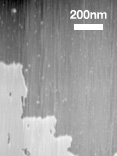
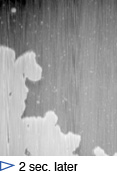
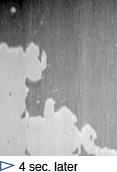
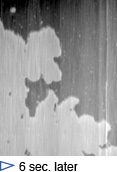
Case 1: Observation of spreading lipid bilayer on mica in liquid, every 2 seconds.
2. High resolution imaging ( BL-AC10FS-A2 )
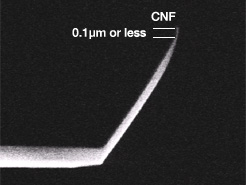
A CNF probe, small fibril with a tip radius less than 10 nm, grows at the end of the triangular portion of bird-beak-like cantilever. CNF probe improves quality of AFM images.
Case 2: High-Resolution Imaging of double helix of DNA strand
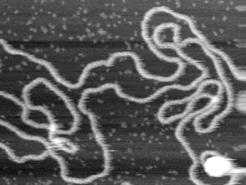
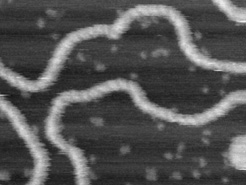
BL-AC10DS-A2 (BioLever fast without CNF probe) is available as before. They can be used for imaging as it is, and also be used as a basic cantilever for modifying, e.g. depositing EBD (electron beam deposition) tip.
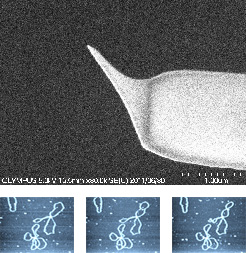
A corner of the triangular protrusion at the end of the bird-beak-like cantilever behaves as a probe tip. The protrusion is a plate-like, 0.8 µm in length and its apex is 24 nm in radius ( nominal ).
In taking AFM movies for observing dynamic behavior of bio samples like DNA strands, the protrusions with relatively large tip-apex often result less scratched lines in the images.
note
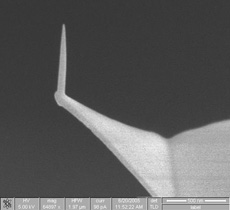
For high resolution imaging with high speed AFMs, EBD tips have been used. It works better than CNF probe in some cases, e.g. observation of relatively large samples. EBD tip with desired length and direction can be made by controlling electron beam irradiation.
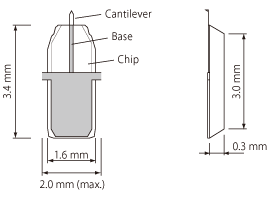
Dimensions of levers and chip (substrates)
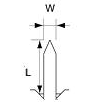
| BL-AC10FS-A2 / BL-AC1DS-A2 | |
|---|---|
| L (µm) | 9 |
| W (µm) | 2 |
| t (µm) | 0.13 |